Dear diary, today I learned that
Balance is not something you achieve. It’s something you keep.
One thing I’ve started seeing more and more is that being a leader is like walking the line.
You feel it almost all the time. Every day is filled with trade-offs.
- You want to speak enough to build trust. But not so much that it creates chaos, confusion, or gets used against you later.
- You want to learn enough to judge whether something makes sense. But not so much that you bog down in details and spend too much time on things that don’t need your depth.
It’s not about choosing one side. It’s about staying somewhere in between. And adjusting all the time.
Leadership Is Paradoxical by Design
I recently finished reading The LEGO Story. Somewhere along the way, it mentioned the 11 Paradoxes of Leadership.
- To be able to establish close relationships with your employees – and to keep proper distance.
- To take the lead – and to recede into the background.
- To show the employee confidence – and to be aware of their doings.
- To be tolerant – and to know how you want things done.
- To be concerned about your own field of responsibility – and at the same time to be loyal to the overall goals of the company.
- To plan your working-day carefully – and to be flexible to your planning.
- To express your opinion – and to be diplomatic.
- To be visionary – and to keep both feet firmly on the ground.
- To aim at consensus – and to be able to cut through.
- To be dynamic – but also thoughtful.
- To be self-confident – and humble
A relief. It looks like it’s not only me who feels this tension. Leadership expectations are inherently contradictory.
Let’s take the number one: To be able to establish close relationships with your employees – and to keep proper distance.
You want to show you’re human. That you make mistakes. That you don’t know everything.
At the same time, you don’t want to send the signal that you don’t know what you’re doing.
You want to know people’s honest opinions. But at the same time, you may not want to share your personal opinion about things decided by upper management — especially if you don’t fully agree with them.
You want people to like you. But this shouldn’t block you from giving correcting feedback when it’s needed.
Or the number 2: To take the lead – and to recede into the background.
You want to be a role model. Show how you want things to be done.
At the same time, you want to leave the stage to others. Let them take ownership. Let them work on the hardest projects so they can grow and gain experience.
Again, both sides matter. Picking only one usually breaks something.
The Ballet Dancer
I once heard a metaphor in the Mariusz Chrapko’s podcast that stuck with me.
From the outside, a ballet dancer standing on the tip of her toes looks almost still. Calm. Stable.
But to stay there, she has to keep balance all the time. Her whole body is in constant tension, making tiny adjustments.

When I think back, good leaders always seemed confident and calm to me. Like they had things under control.
Now I understand that inside they were probably under constant tension. Making dozens of micro-adjustments I never noticed.
The calmness was the result — not the absence — of effort.
Spinning Plates
Another metaphor I like comes from 📚The Manager’s Path — spinning plates.
You have a set of plates spinning on sticks. Your job is to go from one to another, giving each just enough attention so it doesn’t fall.
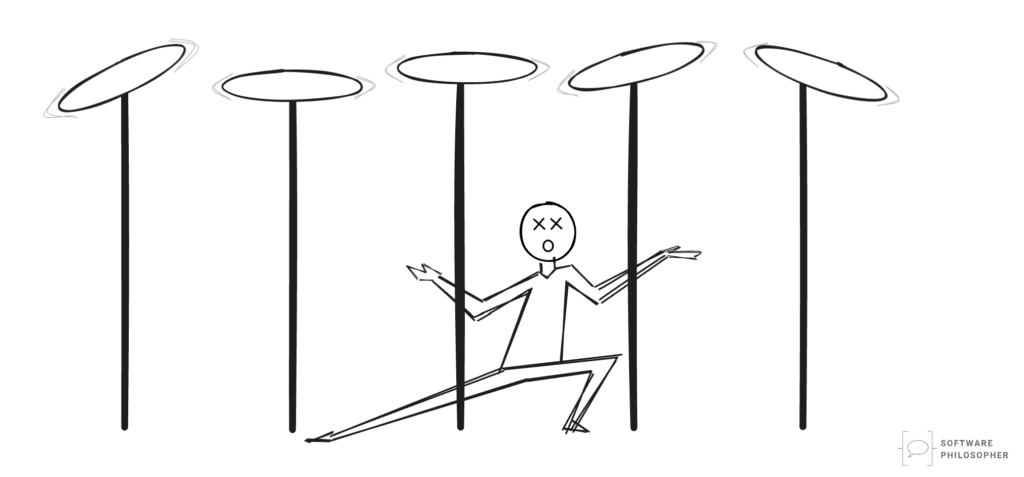
You have to be in constant motion.
If you stop moving, things fall.
Important observation: when one plate spins fast, another one slows down. That’s inevitable.
Occasionally, some plates fall anyway. That’s also inevitable. Especially at the beginning, before you develop the instinct of which plate you should head to next.
The Elevator
When I was an individual contributor, I used to see my manager as a guy who sits in an elevator and travels between floors all the time.
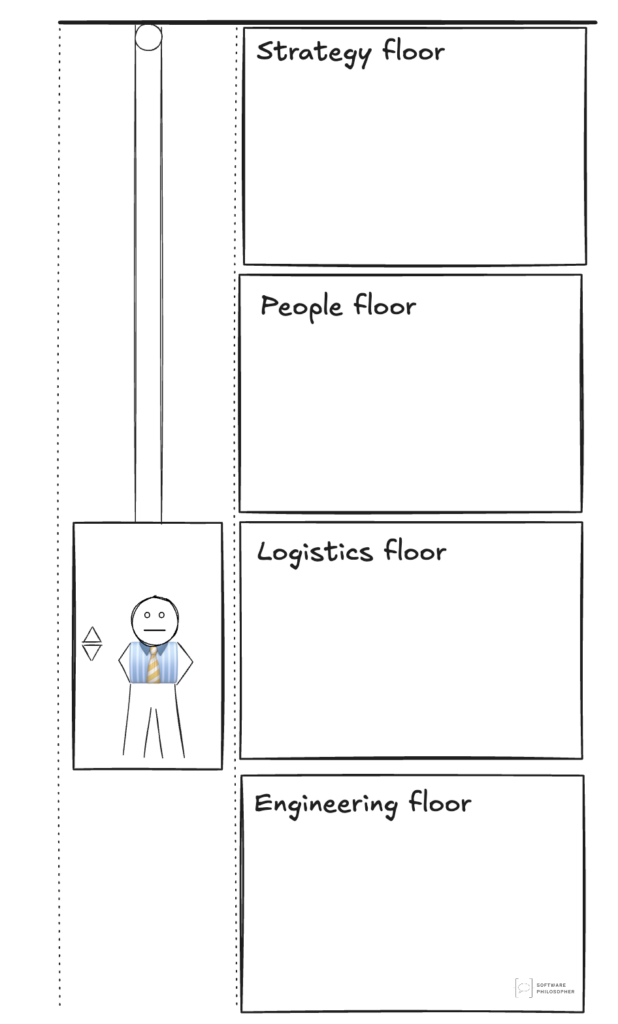
There was the strategy floor — product direction, thinking about team setup, long-term plans.
The engineering floor — helping debug production issues, discussing observability tooling, acting as a rubber duck.
The people floor — one-on-ones, retrospectives, performance reviews.
The logistics floor — planning team gatherings, hiring, budgets.
One hour he talked to me about my growth. The next hour he spoke with the head of product about strategy. Then he joined a debugging session and asked drilling questions to help find the root cause of a nasty issue. Shortly after that, he switched to planning the budget for a team gathering and next quarter’s hiring.
Each floor has a different mental setup.
Different time horizons — minutes versus months.
Different success criteria.
Different emotional loads.
Different language.
Having become a lead, I can now feel how exhausting switching mental operating systems really is.
Sometimes I feel drained without knowing why. Busy, but unproductive. Like I didn’t really finish anything.
Initially, I interpreted this as: I can’t focus anymore. I’m being interrupted all the time. I’m doing shallow work instead of deep work.
It took me some time to understand that the movement is the work.
If you stayed on just one level:
- Only strategy → disconnected from reality
- Only debugging → no leverage
- Only people → no technical credibility
- Only logistics → no leadership
This reminds me what Andy Grove calls leverage in 📚High Output Management. You spend 30 minutes on one floor, share your thoughts, unblock or inspire something — and that work continues for hours while you’re already on a different floor, doing the same thing there.
Balance Is Not a State
All of this led me to one conclusion.
Balance is not something you achieve. It’s something you keep.
It’s not a stable position you reach and relax in. It’s constant movement, correction, and tension — like the ballet dancer, like spinning plates, like riding the elevator up and down all day.
This is also one of those things that are impossible to fully learn from books.
Books can give you metaphors. Experience gives you instinct.
The instinct that tells you which plate needs attention now.
Which floor you should be on next.