These are my notes from the book: High output management by Andy Grove
This book was listed on my 2025 reading list. See other books 👉 here
Initially I was a bit skeptical whether I should read it. This book is 42 years old now. Working in software engineering, I’m a bit used to the fact that some knowledge becomes outdated in 5-10 years. But this was not the case here – it aged remarkably well.
First of all, this is not a book about software engineering, even though Intel plays the main role here. Sure, some parts may seem a bit archaic. But the core knowledge stays valid.
It gave me perspective on optimizing processes, motivating team members, getting the best out of them (I liked the idea that even if you’re satisfied with the performance, the review is always an opportunity to improve things even further), adding some structure to my understanding of responsibilities of the leader (information gathering, nudging, decision making, being role model).
It’s still worth reading.
- Intro
- 1. The Basics of Production: Delivering a Breakfast (or a College Graduate, or a Compiler, or a Convicted Criminal)
- 2. Managing the breakfast factory
- 3. Managerial leverage
- 4. Meetings – the medium of managerial work
- 5. Decisions, decisions
- 6. Planning: Today’s actions for tomorrow’s output
- 7. The breakfast factory goes national
- 8. Hybrid organizations
- 9. Dual reporting
- 10. Modes of control
- 11. The sports analogy
- 12 Task-relevant maturity
- 13. Performance appraisla: Manager as Judge and Jury
- 14. Two difficult tasks
- 15. Compensation as Task-relevant feedback
- 16. Why training is the boss’s job
Intro
As a manager: it’s not about how smart you are, or how well you know the business. It’s about how that translates to the team’s performance and output.
When a person is not doing his job (…) he is either not capable or not motivated
1. The Basics of Production: Delivering a Breakfast (or a College Graduate, or a Compiler, or a Convicted Criminal)
Limiting step. Something that takes the longest and is most expensive.
Examples:
- boiling eggs: Build on top of the egg boiling time
- hiring students: The trip is expensive. Reduce by using phone screening.
Key concepts:
- Process
- Assembly
- test
- rework
- offset
2. Managing the breakfast factory
There are also limitations e.g if you have to wait for the toaster. The key is to make it cost-effective
- equipment capacity – new toaster
- manpower – separate people for boiling eggs, making toasts etc
- inventory – making toasts continuously
Making continuous production reduces flexibility.
It can happen that the machines break silently:
- functional test e.g. opening the egg but you lose egg in the process
- in-process inspection e.g. insert thermometer into boiling water
- incoming inspection – the egg can be rotten or too small (so it boils faster)
- raw material inventory – if you had to sent back rotten eggs
- opportunity at risk – how many customers would you loose if the egg-boiling machine broke
During the process we add value. We need to fix issues at the lowest-value stage possible. E.g. inspecting rotten egg rather than letting the customer discover it.
You need indicators measuring multiple aspects of the business. If you measure it, you can take actions to correct.
You also need pairing indicators to counteract. E.g. one is inventory level when you want to go down, but also incidence of shortages.
An effective indicator will cover the output of the work unit and not simply the activity involved.
Quantity should be paired with quality.
If you think about process as a black box (materials + labor as input), the leading indicators are like making holes in the box. They give signals what to watch out for. You need to trust them to act on something you’re not sure is a problem yet, so they must be good. They tell us if problems lie down the road. E.g. machine downtime.
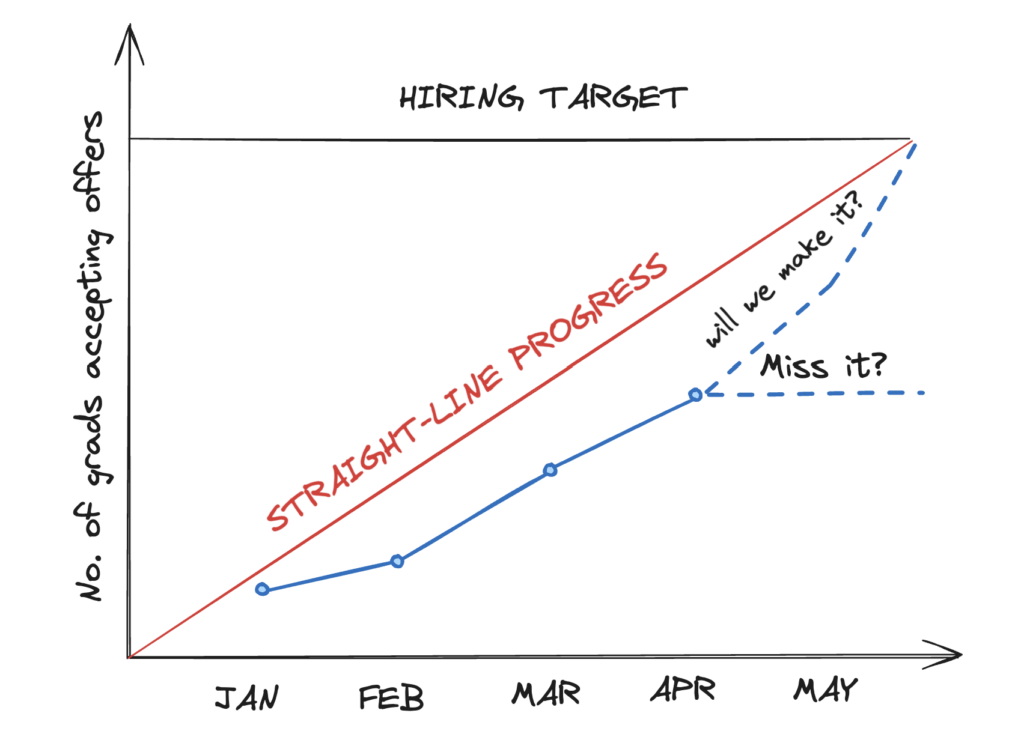
The linearity indicator can give us an early warning that we are likely to miss out target
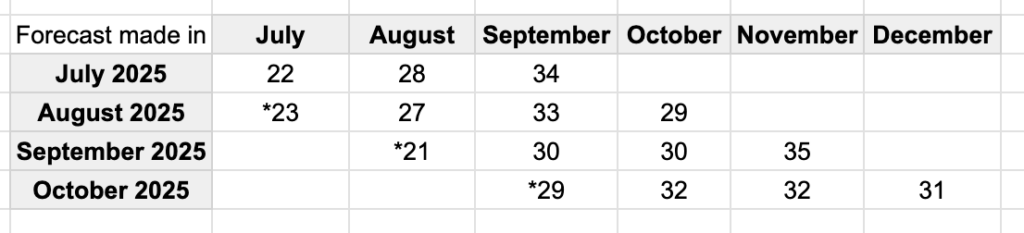
Stagger chart – used to forecast and compare the actual results against forecast
Build to order – a customer orders, you build it. But it is usually build to forecast where you try to forecast what the customer may want so that once the order comes in, you have it ready. E.g. ordering eggs for the restaurant is also this type of forecast. You need to know how many eggs to order.
Variable inspection – can increase efficiency as the problems don’t happen reguarly. Example of sampling visa checks instead of doing thorough check on every one.
Leverage – doing things smarter, not harder. E.g. a waiter with 2 toasters can do twice as many toasts without too much more effort.
Work simplification – list out the process and question each step to reduce the process.
3. Managerial leverage
Manager’s output is the output of people under their influence.
Sport analogy: the coach himself doesn’t bring results with his activities.
Example day – Purposes of different activities : information gathering, nudge, decision making, being role model
Writing the report is more important than reading it. Because it imposes discipline, requires structuring your thoughts. It also serves as a safety net for things that you may not hear in 1:1. Sometimes the discipline of the process is more important than the outcome.
Two types of decisions:
- future-looking
- responding to developing problems
Nudging: suggesting an action, sharing opinion, making a comment, advocating a preferred course of action
Output = activity * leverageYou can increase leverage by:
- affecting a group of people over longer period of time:
- coming prepared to the meeting
- performance review
- sharing values
- offering your focused time in a timely manner
- e.g. talking to valued employee who decides to quit
Leverage can also be negative e.g if you come to the meeting unprepared, or meddle (micromanage) which can result in a person losing their initiative.
When you delegate you’re still responsible for the results. That means you need to monitor. So it’s easier to delegate things you know well because you know how to monitor.
Time management can have multiple analogies to factory:
- limiting step – things that can’t be moved. You plan your time around them.
- batching work
- slack – to not work on the capacity
- saying no to not have bottlenecks
- inventory – a list of topics to cover that will increase team’s productivity when you have free time
- standard product – having standard answers for most common interruptions. Answering can be delegated to others.
4. Meetings – the medium of managerial work
- process-oriented meetings – regular, focused on knowledge sharing, information exchange
- they should be regular and same structure so that people can make forecasts how much preparation takes and what to expect
- examples: 1:1, staff meeting, operation review
- something of a 1on1 can help family at home e.g. with each child separately. Not literally but taking inspiration
- mission-oriented meetings – ad hoc, focused on making a decision
- if things go well, majority of the decisions should be made on routine meetings
5. Decisions, decisions
Ideal decision making process
- free discussion
- clear decision
- full support
Key questions to ask:
- what decision needs to be made
- when does it have to be made
- who will decide
- who needs to be consumed prior to making the decision
- who will ratify or veto the decision
- who will need to be informed
6. Planning: Today’s actions for tomorrow’s output
- 1. Environmental demand
- What other groups demand from you.
- 2. Present status
- 3. What to do to close the gap
- what do you need to do and what can you do.
- one level’s strategy is the other level’s tactics.
OKR example:
- Queen’s objective – increase wealth
- Columbus objective – find a new route to Orient
- KRs – organize ships, the crew
- the nesting of the objectives.
- Columbus did not meet his objective despite meeting KRs, but met Queen’s objective.
7. The breakfast factory goes national
Examples of different challenges when you scale. Centralized vs decentralized
8. Hybrid organizations
Two extremes
- mission-oriented groups – each group has everything they need (decentralized). E.g. north region
- functional groups – centralized. E.g. sales group, accounting group
The secret is to find the right hybrid balance
9. Dual reporting
Two-plane organization.
It’s completely normal that you belong to multiple hierarchies. E.g. If you work at Intel you’re part of Intel’s hierarchy and at the same time you can be a part of the Church.
Similarly you can be a part of the mission project that will cease to exist after some time.
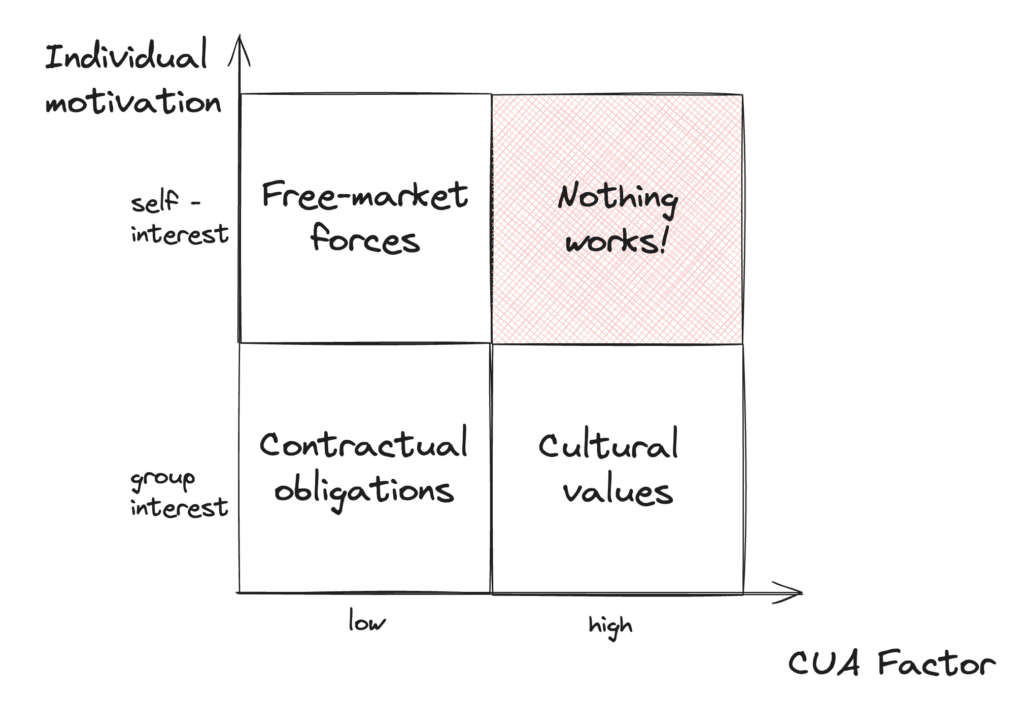
10. Modes of control
- free market forces
- e.g. buying tires
- contractual obligations
- e.g. stopping at red light
- they introduce overhead e.g. police or supervisor
- culture values
- e.g. helping someone during an accident
- do it by setting an example
complexity, uncertainty, ambiguity: the “CUA factor”
11. The sports analogy
In the past motivation came from fear because output of labor work was easy to measure and take immediate steps. That doesn’t work with knowledge work.
Take Maslow’s hierarchy – if one need is satisfied you’re no longer motivated. The secret is to keep a good balance of lacking satisfaction so that people can be motivated.
- physiological
- safety / security
- social / affiliation
- esteem / recognition
- self actualization
- competence-driven or achievement-driven
- create environment to foster achieving.
- the objective should be high enough that require a stretch
- to cultivate achievement-driven motivation you need to create an environment that values output.
At the upper level of the need hierarchy money is not a source of motivation but a measure of achievement.
If the absolute sum of a raise in salary is important to you, you’re working within physiological or safety modes. If it matters for you how you stack up against other people you are motivated by esteem/recognition or self-actualization.
The mere fact of competition may motivate us to perform better to beat “the others”.
12 Task-relevant maturity
Somone may have high general competency, but put into new situation may be less productive. His general maturity is high, but Task-relevant maturity is low.
Task-relevant maturity (TRM) of subordinate :
- low: structured; task-oriented; tell what, when and how
- medium: individual-oriented; emphasis on two-way communication, support, mutual reasoning
- high: involvement by manager minimal: establishing objectives and monitoring.
Structure moves from being externally imposes to internally given.
You want to increase TRM asap. It’s more expensive to constantly supervise and give instructions. With high TRM you can delegate more often increasing managerial leverage.
13. Performance appraisla: Manager as Judge and Jury
The purpose of performance review is to increase performance and motivate.
Manager’s performance review needs to take offset into account. If the org is doing good but people are unhappy it could be still state from the previous manager.
On its basis it’s explaining to subordinates what you expect and how they meet expectations. But that’s not easy.
It’s easy to fall into “potential ” trap. We need to assess performance, not potential. The performance review of a manager shouldn’t be higher than the one of his organization.
Whom we promote crates a new role model.
Always try to improve performance and find something to improve. Even if the person is performing well.
Delivering the assessment:
- a person has limited capacity to deal with facts, issues, suggestions. Don’t throw everything at once
Stages during delivery of bad performance review:
- ignore
- deny
- blame others
- assume responsibility
- find solution
Don’t confuse emotional comfort with operational need. To make things work, people don’t need to side with you; you only need them to commit themselves to pursue a course of action that has been decided upon.
Finding ways to improve for good performers has a big leverage, although it’s just easier to focus on justifying good review.
The most optimal way to deliver the review is to give it to read before and then talk.
14. Two difficult tasks
Interviewing – things to asses
- technical knowledge – what they know about performing the job
- describe some projects
- what are your weaknesses
- how this person performed in an earlier job using their skills – what he did with what he knows
- past achievements
- past failures
- discrepancy between what he know and what he did
- what did you learn from failures
- problems in current position
- operational values
- why are you ready for new job
- why should we hire you
- most important college project/courses
Talking out of quitting:
- the one who’s loyal and doesn’t feel recognized. Not the one that changes the job for more money
- drop all you do. Otherwise you confirm that they are “not important”
- on the first conversation listen. Do not argue, do not convince. It’s not this phase yet.
- to address the fact that he may feel like a blackmailer: “You did not blackmail us into doing anything we shouldn’t have done anyway. When you almost quit, you shook us up and made us aware of the error of our ways”
- if he says he accepted other offer say that he made 2 commitments. With the company he’s been for X years, and strangers.
15. Compensation as Task-relevant feedback
Because on the higher salary money is satisfying self actualization and not basic needs it makes sense to make the salary mostly consist of performance bonus.
Two extremes:
- experience-based – the signal from management: performance doesn’t matter
- merit-based – people need to accept that for someone to be the best, someone has to be last.
The best option is something between.
Promotion can be an opportunity to show that the company values performance.
Peter principle in practice means that people alternate between “meets requirements” and “exceeds requirements”. On level 1 they meet, so they are promoted when they meet again.
Sometimes it can happen that the person promoted does a bad job. It’s difficult but the best thing for the company is to “recycle” and put back into lower position in which we know the person performs well. Management should support the person with the feeling of embarrassment.
16. Why training is the boss’s job
One untrained employee can have huge impact. Example of the waiter who didn’t explain issues with wine when taking a reservation and that their manager had to personally explain it x times.
Manager should do the training personally. Because they know the nature of the organization and that they play a role model.
You can find me on goodreads 🙂